

By the time anyone realized the team was missing, the storm had already erased their tracks.
Dr. Hadiya Rahman stood in the operations tent, staring at the grainy satellite feed on the monitor. The desert looked like an endless sheet of bruised gold, ripples of sand stretching to every horizon.
No vehicles.
No people.
No movement.
“What about their GPS beacons?” she asked.
“They all went dark at 14:32 yesterday,” said Colonel Bouchard, arms crossed. His uniform looked too clean for the chaos outside. “No signal since.”
“And you waited until this morning to call for scientific support?” Hadiya said, unable to keep the edge out of her voice.
“We thought it was a equipment fault. The storm scrambled half our electronics.” He exhaled. “Then we received this.”
He slid a ruggedized tablet across the table.
A single image filled the screen.
Hadiya had seen a lot of strange things in deserts—mirages, ruins, entire rivers buried under dunes—but nothing like this.
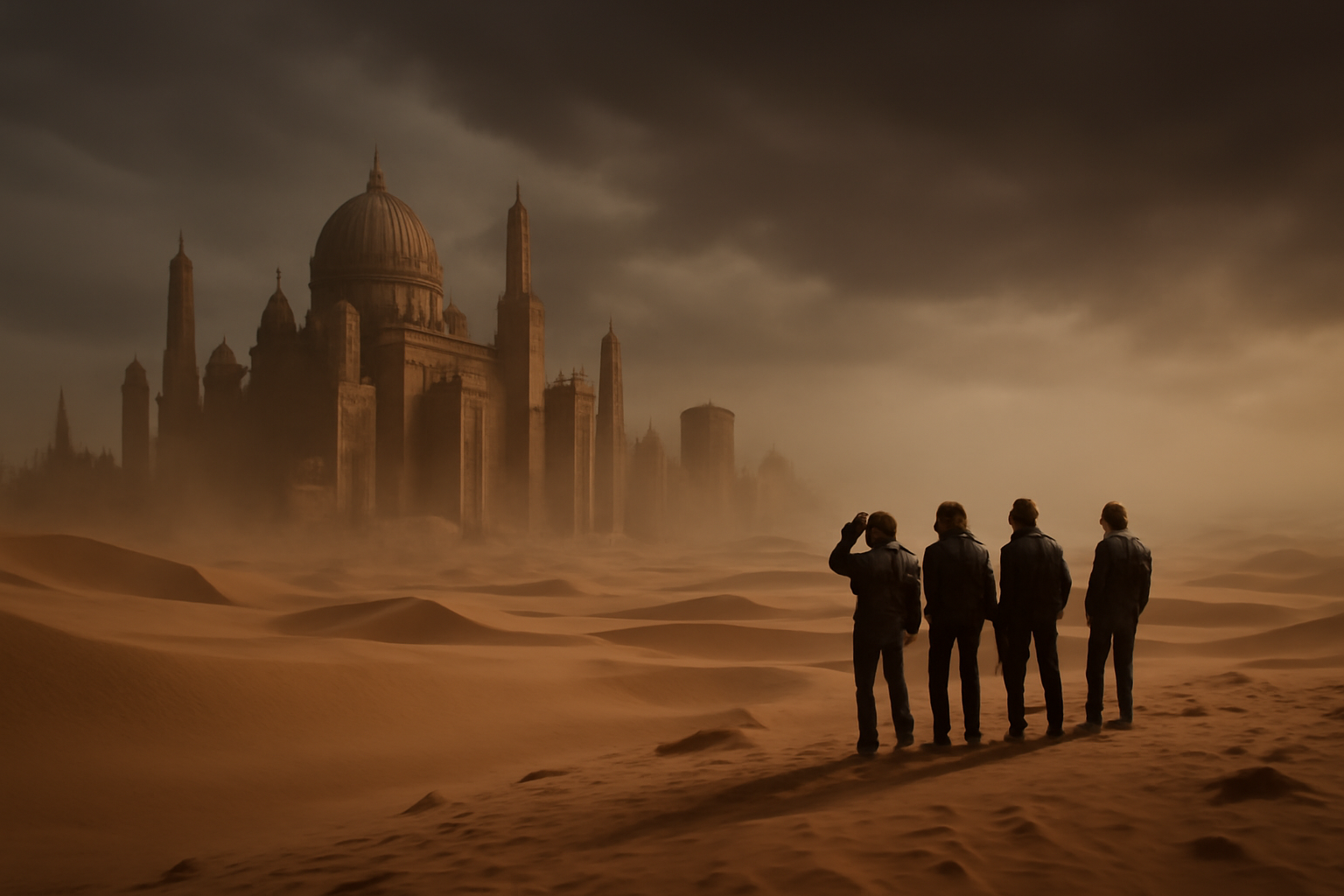
The photo showed a stretch of sand under a thick, storm-dark sky. In the distance, cutting across the horizon, was a city.
Not ruins.
Not low stone dwellings.
Towers. Dozens of them. Tall, slender, glimmering gold and black, rising from the earth like teeth. The architecture was wrong—too smooth, too seamless, no visible joints or seams. Some towers curved, others leaned in impossible ways, yet somehow held their form. The light in the image seemed to bend slightly around them.
Closer to the camera, four figures stood with their backs to the lens—her missing team. The last person in line, Tomas, had half turned his head, as if just realizing something was wrong.
Time stamp: 14:31:52.
Barely seconds before everything went silent.
“Where was this taken?” Hadiya asked.
“Fifty kilometers from here,” Bouchard said. “They were surveying an anomalous density reading under the dunes.”
She zoomed in, trying to sharpen the skyline. The edges of the towers blurred more the closer she focused, as if the city disliked being scrutinized.
“We have no satellite record of any structure like this,” she said.
“There isn’t one,” Bouchard replied. “We checked back months. Years. That area was empty. Until that photo.”
Hadiya swallowed.
“And now?”
He touched the screen, switching to a current drone feed of the same coordinates.
Nothing.
Just sand.
As if the city had never been there at all.
They flew by helicopter to the coordinates, the rotors chopping the dry air into a steady, reassuring rhythm. Hadiya sat by the open door, wind slapping her face as she scanned the dunes below.
“Anything on ground-penetrating radar?” she called over the headset.
“Still getting the anomaly,” Bouchard replied from the other seat. “Something big under the sand. Thirty meters down.”
“But no surface structures?”
“Nothing solid. No geometry. Just… density.”
The helicopter touched down on a relatively flat stretch. Sand whipped around them as they disembarked, visors down, cloth wrapped across mouths and noses.
The air felt wrong.
Not just hot—heavy, like a held breath.
“EM readings?” Hadiya asked.
Her assistant, Leila, checked the handheld. “Fluctuating. Small spikes every few seconds. Like a heartbeat. No obvious source.”
“Set up the GPR rig there,” Hadiya said, pointing to a slight rise.
They deployed quickly, the small ground-penetrating radar unit whining softly as it sent pulses into the earth. Data rolled across the tablet in Leila’s hands.
“Okay, that’s… weird,” Leila murmured.
“Talk to me,” Hadiya said.
“There’s a structure down there,” Leila answered. “Definite solid mass. But it’s not… consistent. Parts of it look like voids, other parts like dense metal. And it’s not buried in layers. It’s like it’s just… there, inside the sand.”
“Dimensions?”
“Rough estimate… at least five hundred meters across.”
“Could be a buried complex,” Bouchard said. “Ancient city swallowed by the desert. Happens all the time.”
“The problem,” Hadiya said, “is ancient cities don’t usually appear suddenly in photographs and then vanish.”
She turned in a slow circle, studying the horizon. It was unnervingly empty.
“Let’s triangulate the exact spot where the photo was taken,” she said.
They did, cross-referencing GPS and the position of the storm front in the image. The precise location turned out to be a low dune crest marked by nothing more than scattered rocks.
Hadiya walked up the slope.
At the top, a gust of wind nearly knocked her off her feet—and with it came a momentary distortion, like a tremor in the air itself.
For a split second, the world flickered.
The desert wavered.
And she saw it.
A vertical line in the far distance. Then another. Then dozens. A cityscape trying to resolve, like a hologram struggling to load.
She blinked. It was gone.
“Hadiya?” Leila’s voice crackled through the headset. “You okay?”
“Did any of you see—”
“No,” Bouchard said immediately. “What did you see?”
She hesitated.
“A trick of light,” she lied, for now. “Just the storm haze messing with my eyes.”
The last thing she needed was panic.
But something was there.
Not fully in their world. Not fully out.
A frontier.
And her team had walked straight into it.
They found Tomas’s pack half-buried in the lee of a dune two hundred meters from the crest.
It hadn’t been there long. The fabric was scuffed but intact. The straps were undone, as if he’d dropped it in a hurry.
No footprints. No tracks. The storm had wiped them clean.
Inside the pack, they found a canteen, three sample jars filled with sand, a portable spectrometer, and a small camera.
Hadiya scrolled through the images on the camera.
Sand.
Bored selfies.
Rock layers.
Then—
The city.
Closer this time.
Towers rising so high they disappeared into the storm clouds. No windows. No doors. Just smooth surfaces etched with faint vertical lines that seemed to shift when she stared too long.
The next image was different.
The same view, but the perspective had changed: lower, skewed as if the camera were hanging from one strap or held at Tomas’s side.
In this frame, a narrow crack had opened in the air ahead of the team. It was subtle, vertical, like a tear in reality. Sand on one side. Cityscape on the other.
The team was walking toward it.
The final image was almost completely white. Just the faint outline of a hand reaching forward.
“No timestamps after that,” Hadiya said softly.
“Radio logs stopped at the same time,” Bouchard said. “As if they stepped off the grid in one second.”
Leila swallowed. “Like crossing a border.”
Hadiya stared at the last image.
Maybe that wasn’t a metaphor.
“What if they did?” she said.
“Did what?” Leila asked.
“Cross a border,” Hadiya replied. “Not between countries. Between… states of reality.”
Bouchard frowned. “You’re suggesting—”
“I’m not suggesting anything yet,” she cut in. “I’m just saying: the city is there, but only sometimes. The anomaly below us isn’t stable in our space. It’s phasing. Drifting.”
“Like a mirage,” Leila said.
“A mirage doesn’t show up on radar,” Hadiya said. “Or leave behind physical packs.”
The ground trembled faintly.
All three froze.
“Seismic?” Bouchard asked.
Leila checked the tablet. “No tectonic activity. It’s local.”
Another tremor.
A low hum rose from beneath the sand, deep enough that Hadiya felt it in her teeth.
The horizon flickered.
This time, everyone saw it.
Towers.
Curving.
Glittering.
Half-there, half-not.
The city rolled in like a ghost wave, emerging from a heat haze that had no source. The dunes in front of them warped, flattening slightly, as if the sand itself were being overwritten by a different landscape.
Leila whispered, “Oh my God.”
The city sharpened.
Line by line.
Tower by tower.
It was beautiful in a cold, inhuman way. No visible entrances. Surfaces smooth and reflective, but not like glass — more like liquid stone. The air around it shimmered, bending light.
Between the dunes and the nearest tower, a narrow vertical slit hung in the air.
The same tear from Tomas’s photo.
“It’s a gateway,” Hadiya said.
“To what?” Bouchard asked.
She swallowed. “To wherever the city is when it’s not here.”
The hum deepened. The slit widened slightly, flickering at the edges. Hadiya’s skin prickled.
“We should leave,” Leila said, voice shaking. “We should call this in, seal the area, let someone else—”
“The longer we wait, the more likely we lose them forever,” Hadiya said.
“We don’t even know if they’re alive,” Bouchard said.
“We don’t know that they’re dead either,” she countered. “We have a window. A literal one.”
Leila stared at her. “You’re not thinking of going through.”
“Yes,” Hadiya said.
Bouchard grabbed her arm. “That’s not your call.”
She met his eyes. “It’s exactly my call. You brought me because the ground lies and the past doesn’t. Under that city, something ancient is still active. It doesn’t care about our protocols.”
She looked back at the slit.
It pulsed faintly in time with the hum beneath their feet.
“We go in,” she said. “We tether ourselves. We record everything. And if it starts to close, we come out.”
She didn’t add if it lets us.
Bouchard cursed softly. “You’re going to get us all killed.”
“Maybe,” she said. “Or maybe we’re already standing on something that doesn’t want us here, and leaving our backs turned is worse.”
Silence.
Then: “Fine,” he said. “Two minutes inside. No more. We go in together. We come out together.”
Leila stared at them both like they were insane. Then she swore and grabbed the rope.
“Of course I’m going,” she muttered. “You two would just die more stupidly without me.”
They anchored a line around a buried truck frame and harnessed themselves in series: Bouchard first, then Hadiya, then Leila. Hadiya clipped Tomas’s camera to her chest.
The tear in the air hung still and silent.
Up close, it wasn’t just a slit. It was a boundary. The air on one side shimmered slightly differently, like the heat above a fire.
Hadiya reached out.
Her hand disappeared.
Not all at once. The fingertips vanished first, then her knuckles, then her wrist. There was no sensation, no heat, no cold. Just… absence.
She took a breath and stepped through.
For a moment, there was nothing.
No sound. No weight. No direction.
Then the world snapped back.
She stumbled onto a surface that wasn’t sand.
It was smooth, hard, faintly warm. She looked down.
The ground glowed softly beneath her boots, etched with faint, intertwining lines like circuitry.
She lifted her head.
The city towered around them in full, impossible clarity.
The towers were closer now, rising into a sky that was not the same dusty blue they’d left. This sky was darker, tinged with violet at the edges. No sun. No visible source of light. Yet everything was bright.
The air felt thicker. Charged.
Leila emerged behind her, gasping. “We’re… inside.”
The rope behind them ran straight back into the slit, which hovered now like a sheet of rippling glass.
“Timer,” Bouchard said, voice tight. “One minute forty.”
They moved forward carefully.
The nearest tower’s surface flowed slightly when Hadiya’s shadow touched it, as if reacting. The lines etched into the ground pulsed in patterns that almost felt like breathing.
“Tomas?” Hadiya called, voice swallowed by the air. “Rana? Ishaan?”
No answer.
But something heard them.
The pulse patterns in the ground shifted. New lines lit, running toward the base of a tall archway up ahead.
Leila pointed. “Look.”
The archway’s inner surface turned dark. Then, like fog clearing, an image appeared—flickering shapes, then clearer.
Her missing team.
They stood in another place, another part of the city, as if captured on a live feed. Tomas was speaking, but no sound came through, just silent movements of lips and hands. Behind him, the architecture folded and unfolded like a living thing.
Hadiya reached toward the arch.
The image blurred.
The ground pulsed sharply.
“Thirty seconds!” Bouchard shouted. “We pull back now!”
“Wait!” Hadiya said. “They’re alive—they’re inside this system. It’s showing them to us.”
“Or luring us deeper,” he snapped.
She gritted her teeth.
He was right.
Every part of her wanted to run toward that arch and keep going until she found them. But every instinct honed through years of digs and collapsed caverns screamed the same truth:
Get out while you still can.
She forced herself to step backward.
The ground dimmed.
The arch’s image faded, Tomas’s hand reaching toward them just as the connection blinked to nothing.
They crossed the boundary again, stumbling into hot, familiar air. The rope snapped slack behind them. The tear in the air narrowed.
Within seconds, the city blurred, its towers fading like smoke. The hum softened.
Then, as if someone flipped a switch, the desert was just a desert again.
Sand.
Sky.
Wind.
Nothing more.
Leila ripped off her visor, eyes wet. “We left them.”
“We found them,” Hadiya said quietly. “That’s more than we had this morning.”
Bouchard exhaled hard, staring at the empty horizon. “What the hell was that place?”
Hadiya looked at the inert sand, remembering the feel of the glowing ground, the silent image of her team behind the arch.
“A frontier,” she said. “Between our world and… something else.”
She tightened her grip on Tomas’s camera.
“And it knows we’re here now.”